
 NEWS
NEWS
Interview of the television channel “CGTN” of China with the National Leader of the Turkmen people, Chairman of the Halk Maslahaty of Turkmenistan
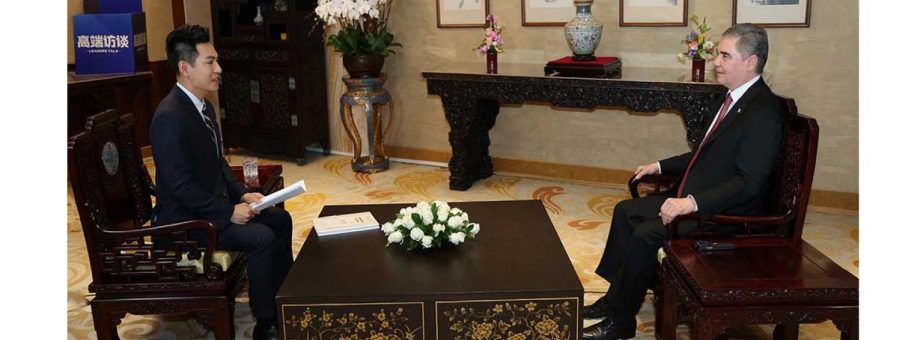
During his friendly visit to the People’s Republic of China, the National Leader of the Turkmen people, Chairman of the Halk Maslahaty of Turkmenistan Gurbanguly Berdimuhamedov gave an interview to the television channel “CGTN” of China. Prior to the interview, he had a conversation with the anchor He Yankai, during which they exchanged views on the current state and future vectors of cooperation between the two countries.
It was noted that cultural and humanitarian ties between Turkmenistan and the People’s Republic of China form the basis of international cooperation between the two countries. In this regard, the journalist emphasized that he has a deep interest in the life, work and books of the National Leader of the Turkmen people.
Then the CGTN presenter He Yankai kindly asked the Chairman of the Halk Maslahaty of Turkmenistan to make a commemorative entry in the Channel’s Guest Book.
After leaving the commemorative entry in the guest book of the world-renowned “CGTN” television channel, the National Leader of the Turkmen people expressed his confidence that the relations established between the two countries would continue to develop comprehensively.
This was followed by an interview with the Chairman of the People’s Council of Turkmenistan by the anchor of the Chinese television channel “CGTN”.
– Dear National Leader, thank you for your time dedicated to this interview. Our first question: how would you describe relations between Turkmenistan and China, and between the Turkmen and Chinese peoples in general? How is this cooperation developing?
– Before answering your question, I would like to thank the management of CGTN for taking the initiative to organize this interview. Answering questions from such a reputable channel, which has an audience of millions both within China and beyond, will help to strengthen relations between our two countries.
This will enable people to learn more about modern Turkmenistan, to understand the specifics of its domestic and foreign policy, and our state programmes and priorities.
And now let us turn to your question.
To present an objective picture of relations between Turkmenistan and China, and between our peoples, it is necessary to know and understand their history.
These relations have never disconnected: over the centuries, a unique geographical, political, economic and cultural space has been formed.
Thus, Turkmen and Chinese people have lived in harmony and cooperated. They have accumulated experience and developed their own customs and traditions, sharing their knowledge, skills, as well as spiritual and material values, which has raised the level and enriched the essence of modern relations between the two countries and peoples.
It is therefore entirely natural that there should be traditions of friendship, good-neighborliness and mutual trust between Turkmenistan and China. And we are proud of this. Today, our cooperation, which has been tested by time, is based on shared experience – objectivity and openness.
In this context, I feel it is appropriate to mention a unique document – the “Treaty of Oath” – which was signed in 49 BC between the ancestors of the Turkmen and the Chinese people.
The very title “Treaty of Oath” indicates that relations between the two peoples are based on firm and sacred principles.
Today, the leaders of Turkmenistan and the People’s Republic of China are reviving the spirit and traditions of this cooperation, drawing on our rich historical roots.
Both countries look back on a history of inter-state relations stretching back thousands of years, beginning with the era of the Great Silk Road. This is our greatest advantage, the foundation of our friendship and mutually beneficial, equal cooperation.
– How is the Turkmen-Chinese partnership developing, and in what areas?
– Let’s start with political and diplomatic cooperation.
China was one of the first countries to recognize Turkmenistan’s independence. It became the first country in the world to establish diplomatic relations with our country on 6 January 1992.
On 3 September 2013, a Joint Declaration on the Establishment of Strategic Partnership Relations between Turkmenistan and China was signed.
With the signing in January 2023 of the “Joint Statement of Turkmenistan and the People’s Republic of China”, our countries reaffirmed their commitment to developing comprehensive strategic relations. These documents demonstrate that the Turkmen-Chinese partnership has reached a high level of inter-state cooperation.
Both states cooperate effectively in the field of foreign policy. Approaches to bilateral diplomatic relations and consultations have been established. Within the framework of major international organizations, primarily the United Nations, a practice of mutual support has been established, demonstrating mutual understanding and the engagement of effective methods of interaction on pressing issues on the global and regional agenda.
I highly value China’s unwavering support for Turkmenistan’s neutrality and our international initiatives, and I thank you for this.
In turn, Turkmenistan always clearly affirms its position on issues of importance to our Chinese friends, including those concerning the territorial integrity and indivisibility of China.
Turkmenistan highly appraises the role of the People’s Republic of China as one of the founding members of the Shanghai Cooperation Organisation.
Our country participates in the Shanghai Cooperation Organisation Summits as a guest of honour. Partnerships are also being strengthened within the “Central Asia–China” framework, established on the initiative of our countries.
For many years, China has been Turkmenistan’s largest trade and economic partner. From 2007 to present, trade turnover between our countries has increased by twenty times.
It is worth noting the stable level of trade turnover, which reaches 9–10 billion US dollars each year.
Our cooperation covers such key areas as energy, transport, communications, high technology, the textile and agro-industrial sectors, and various others.
We have accumulated unique experience of mutually beneficial partnership in the oil and gas sector. There are also promising developments in the field of renewable energy, taking into account the experience and capabilities of the People’s Republic of China.
Our transport sector is developing rapidly in cooperation with China. Let me give some specific examples: 90 percent of the carriages and locomotives functioning on Turkmenistan’s railways are manufactured in China.
In addition to the procurement of Chinese carriages and diesel locomotives, we are collaborating on the development of East–West transport and transit corridors.
In 2014, a railway line stretching over 750 kilometers was commissioned; it runs through the territories of neighboring countries and connects China with Turkmenistan.
In recent years, purchases of Chinese vehicles, mainly buses, have increased significantly.
I am confident that our countries have all the necessary conditions to unite resources for the development of trade routes in the Caspian Sea, with access to terminals in the Persian Gulf and the Indian Ocean.
I would like to note that all this is in line with China’s “Belt and Road” initiative and Turkmenistan’s “Revival of the Great Silk Road” strategy.
In today’s world, the existence of objective mutual interests allows Turkmenistan and China to successfully develop cooperation in the context of implementing major transport and logistics projects.
This is intended to give a powerful impetus to the economic development of Eurasia, uniting vast territories from the Pacific to the Atlantic Oceans on modern principles, as well as forming interconnected production and technological cycles and industrial belts. At the same time, this will contribute to the resolution of many social problems and to improving the quality of life and well-being of the peoples.
In the agro-industrial sector, Turkmen and Chinese specialists are working with specific varieties of crops that have long been cultivated in Turkmenistan.
We are also ready to cooperate closely in the field of urban planning and the development of modern ‘smart city’ systems. China is recognized as a global leader in this field.
The agenda for cooperation also includes high technology, telecommunications and space exploration.
– You mentioned the energy sector as one of the key areas of partnership. How is work progressing in this field?
– The fuel and energy sector is a strategic focus of Turkmen-Chinese cooperation. And this is understandable: our countries possess enormous potential in this sphere.
As is well known, in April 2006, the Government of Turkmenistan and the Government of the People’s Republic of China signed a General Agreement on the implementation of the Turkmenistan – China gas pipeline project and the supply of Turkmen natural gas to the People’s Republic of China.
The gas pipeline was commissioned on 14 December 2009. Since then, Turkmenistan has been supplying China with approximately 40 billion cubic meters of gas per year, in accordance with the Agreement.
As of 1 March 2026, approximately 460 billion cubic meters of natural gas has been supplied to China via the Turkmenistan – China gas pipeline. We are currently working together to increase gas export volumes to 65 billion cubic meters per year.
Such a gas strategy serves the long-term interests of Turkmenistan and China and is in line with global economic trends. At the same time, the role of energy supplies is growing. It also demonstrates the development of open cooperative relations based on equality, opportunities and prospects for the future.
Ultimately, this pipeline is a real, practical example of taking into account the interests of all participants in energy projects – producers, transit countries and consumers. It is worthwhile emphasizing here the convergence of positions between Turkmenistan and the People’s Republic of China on issues concerning the reliable and secure supply of energy resources to world markets.
I would like to highlight one important development: the Chinese company CNPC has won the international tender to develop one of the world’s largest gas fields “Galkynysh” located in southeastern Turkmenistan. This project is designed to provide an additional 10 billion cubic meters of natural gas annually.
Thus, a robust infrastructure network for the export of Turkmen energy resources to China is being developed jointly and systematically to ensure long-term, uninterrupted supplies. I would like to highlight particularly the meticulous work of our Chinese partners, who have been involved in the development of Turkmenistan’s gas fields for many years.
Chinese experts will continue their work and expand their activities in our country, which is in line with the fundamental interests of both nations and the objectives of energy stability and security on the Asian continent.
– How do you assess, in general, the prospects and objectives of Turkmen-Chinese intergovernmental cooperation?
– Its future is clear, as our relations are developing steadily and are designed to last for decades to come. Both sides understand the need to unfold the enormous potential we possess for the benefit of our peoples and states.
On this basis, appropriate mechanisms are being established. One of these is the Turkmen-Chinese Cooperation Committee which was formed in 2008.
Its main objective is to ensure cooperation between the two countries in key areas such as security, trade, energy, science and technology, as well as cultural and humanitarian ties.
In the field of security, this involves a joint fight against three threats: terrorism, extremism and separatism, as well as various forms of cross-border crime. In accordance with the bilateral documents signed, our relevant agencies are currently working to ensure cyber and biological security.
Turkmenistan and the People’s Republic of China are active and engaged participants in regional affairs.
In 2021, on the initiative of Turkmenistan and with the support of China, a new cooperation framework was established – meetings of the foreign ministers of Afghanistan and neighboring countries. Turkmenistan and China are jointly making a significant contribution to its activities.
The aim of this format is to achieve lasting peace and harmony in Afghanistan and to rebuild the country – essential elements for ensuring and strengthening security and economic development in Asia. Alongside this, we are working together on a number of other multilateral initiatives in the field of security.
We must also implement the measures defined by our heads of state to increase and diversify trade volumes and enhance the role of the private sector in economic cooperation.
Scientific and technological cooperation is also of exceptional importance. The Turkmen and Chinese sides are constantly working to address these challenges.
– What role do cultural and humanitarian ties play in the strategic partnership between Turkmenistan and the People’s Republic of China?
– These relations play a very important and defining role because the state system, sovereignty and national identities of Turkmenistan and China are rooted in deep historical, spiritual and cultural ties. As we build inter-state cooperation in the modern era, we enrich these ties, consider them and are inspired by them.
This is a significant advantage that enables Turkmenistan and China to set clear, shared goals for one another and find ways to achieve them.
It is entirely natural that particular importance is attached to cultural, scientific and educational cooperation, and that state support is provided in this regard, as reflected in mutual Days and Years of Culture in various formats, the organization of visits and performances by artists, as well as festivals and conferences. Talks are currently continuing to open Cultural Centres of Turkmenistan in China and Cultural Centres of China in Turkmenistan.
I would particularly like to highlight cooperation in the field of education. Presently, more than 10,000 citizens of Turkmenistan are studying at the educational institutions in China.
Chinese is taught at nine higher education institutions and ten secondary schools in Turkmenistan.
For our part, we are ready to assist in organizing the teaching of the Turkmen language in educational institutions in the People’s Republic of China and to send teachers and specialists for this mission.
This is an investment in the future of our cooperation, a vivid symbol of friendship and mutual understanding between the Turkmen and Chinese peoples.
According to the Eastern calendar, 2026 is the Year of the Fire Horse. In our country, this year is being held under the slogan “Independent, permanently Neutral Turkmenistan – the Homeland of Purposeful Heavenly Horses”.
I make reference to this for a reason. After all, horses, the “heavenly” stallions, are one of the symbols of the shared historical heritage of the Turkmen and Chinese peoples.
As is well known, in the 2nd century BC, the Turkmen people presented the Emperor of China with their “heavenly” horses – the legendary Akhal-Teke stallions. This was an important diplomatic gesture of friendship and an occasion of strategic significance.
There is great potential for horse breeding to become an important area of cooperation. Chinese horse breeders are members of the International Akhal-Teke Horse Breeding Association. The President of this Association is the Head of our State. We invite Chinese horse breeders to the events to be held in Turkmenistan this year.
– How do you assess the current global situation, and what role do Turkmenistan and China play in the current developments?
– The current situation is complicated. However, despite this, I believe there are opportunities to settle the situation, resolve the conflict and move towards a civilized dialogue. The United Nations possesses the necessary tools and potential in this respect, which should be engaged.
As a neutral state, Turkmenistan does not intervene in conflicts. In this regard, our country does not support the use of force in international relations. For us, this is not merely a practical political issue, but, above all, a moral one. First and foremost, wars affect people, influencing their destinies, lives, dreams and hopes.
During a war, one can lose everything in an instant. Therefore, instead of intensifying the efforts towards wars, we must unite ten times more efforts to prevent the wars. Here I would like to quote the prominent medieval Turkmen political leader Bayram Khan Turkmen, who said: “The ability to win is nothing compared to the art of living in peace and harmony”.
Turkmenistan and China are firmly committed to peace, good-neighborliness and harmony. Our countries are working together to do everything possible to foster an atmosphere of trust and mutual respect in global politics, which serves as yet another powerful, fundamental force uniting our brotherly peoples and states.
However, if I were to answer your question not as a politician but as an ordinary citizen, my view is this: once an arrow is released, it cannot be recalled. It makes no distinction between a warrior and a soldier, an ordinary citizen and a child. Unfortunately, it leads only to casualties. If we look to history, we can see that there are no winners in war.
To sum up what I have said, I would like to wish all of humanity prosperity, peace and a happy life.
– As a long-standing friend, what kind of leader do you see President Xi Jinping as?
– We share a warm friendship with the President of the People’s Republic of China. Over the years, we have established political, economic and humanitarian cooperation between our countries, implemented large-scale joint projects, and united our efforts and capabilities to achieve regional, as well as global security and sustainable development.
Relations with President Xi have always been characterized by openness, mutual trust and clarity.
Xi Jinping’s unwavering and firm protection of China’s national interests, coupled with his highly responsible approach to key international issues, have earned him respect and honor as a leader of world level.
Under his leadership, China has achieved significant achievements in all areas and is developing programmes for the future. This is fully confirmed by the outcomes and decisions of the recent sessions of the National People’s Congress and the National Committee of the Chinese People’s Political Consultative Conference.
I would like to take this opportunity to congratulate the Chinese people on this important event.
Speaking of President Xi’s international activities, I would like to highlight the four global initiatives he has put forward:
‘Global Security Initiative’;
‘Global Civilization Initiative’;
‘Global Development Initiative’;
‘Global Governance Initiative’.
I regard these initiatives as strategically significant and vital for humanity.
President Xi’s four initiatives are consistent with the essence and strategic vector of Turkmenistan’s global initiatives, such as ‘Peace through Development’ and ‘Dialogue as a Guarantee of Peace’, which open up the most effective conditions and opportunities for cooperation between our countries.
I believe that Xi Jinping, as a leader, plays a decisive role in the development of the great Chinese state, which is a significant foundation for security and sustainable development in the world.
In this regard, I would like to conclude by saying that if all goes well in China, all will go well throughout the world. I wish the esteemed Xi Jinping – an outstanding individual and a leader of world level – good health, family well-being and continued success in his state affairs, and I wish the people of China prosperity.
Thank you!